Radio Bytes
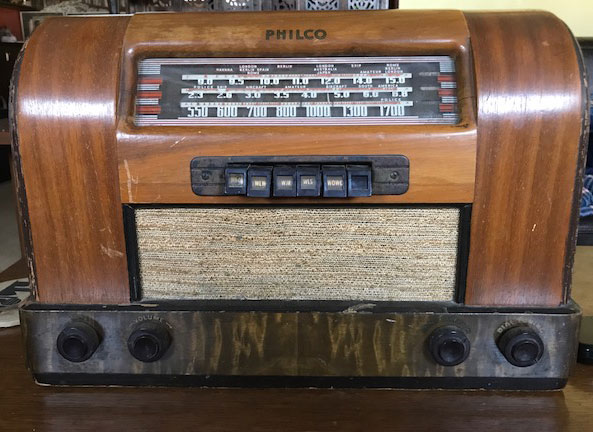
Lately, I have been obsessed with radio’s, antennas, and H.A.M. I suppose that this obsession comes from perusing through Shortwave radio bands as a kid. Listening to those “number counts” that the spy’s used to transmit. Or, perhaps the late nights that I drive home from band practice. I confess, I am a dial flipper. I enjoy discovering those strange AM stations that get bounced off the Ionosphere late at night. One of my favorite stations is a Canadian station, Zoomer Radio out of Toronto, Canada. It took me a while to actually figure out what this station was that I was hearing from the deep, dark black. It almost sounded like a time-warp. I was picking up 1940’s style radio with the actual old commercials. How strange. It was like something out of the Twilight Zone, right?
Back in the 1930’s, my grandfather would build cat whisker, crystal radios. I remember the stories he would tell about how he would construct these radio’s for his friends. Being a tech nerd, I thought about this and decided to do some research on how these things were constructed and perhaps actually build one.
First, I need to learn about how radio works and the terminology associated with radio. I have never formally studied radio or electrical engineering, so I am basically starting from square one. This post will basically be notes and terminology to help me to understand and remember. This will be elementary to seasoned radio folks; however, I want to learn, so here it is.
Modulation – The process of sending a carrier signal or waveform. The waveform transmits information to be collected through the DE-modulation process. Crystal radio will receive amplitude modulated (AM Radio) signals.
Rectifier – A rectifier converts AC current to DC current. The rectifier will keep current moving in one direction. In the case of Crystal radio the rectifier is actually the crystal itself. The crystal was originally composed of a mineral called Galena. Galena is also used to make lead.
Crystal radios do not have a external power source. These radios are powered by the actual radio signals to produce the sound.
Transducer – Converts energy from one state to another. In the case of the crystal radio, The transducer transforms the electrical signals to audio.
Resources:
http://www.hpfriedrichs.com/
https://en.wikipedia.org/wiki/Crystal_radio
https://www.electronics-notes.com/articles/radio/radio-receivers/how-does-crystal-radio-work.php